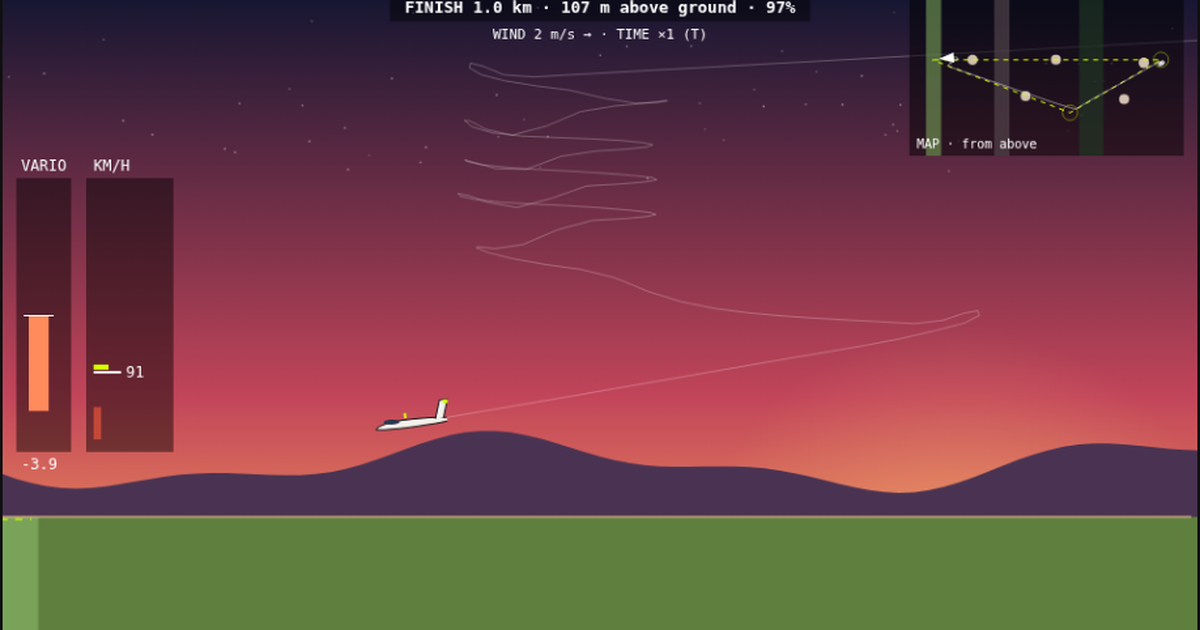

Flight
Airspeed
Vario
Above ground
Glide now
Bank
Task
Time
Time speed
Sailplane, no engine
A long white wing, a summer evening and no engine. Glide down to the airfield, then find a thermal under a cumulus cloud, circle with the birds and climb. Soar a ridge in a strong wind, ride the smooth wave behind a mountain and fly a cross country route round turnpoints as the sun goes down.
The glider sinks all the time, so every climb is earned. The autotrim flies the right speed for you, so it is easy to pick up. When the vario beeps, circle. Land on the mark, or out in an open field when you cannot get home.
Daily Drop · same task for everyone, every UK day
Seven flights, each a little harder. The first is a simple glide home.
Keys: A and D bank, W and S faster and slower, Space airbrakes, T speeds up time, P pauses. On a phone, use the buttons under the picture.
Hold A or D to bank; let go and the bank holds, so you can circle hands off. Level the wings to fly straight. W and S trim faster or slower. In lift the vario beeps: circle in it, and move the circle towards where the beeps are strongest. Hold Space for the airbrakes on the approach. T speeds up time on long glides; it drops back low down. P pauses, R flies again, N goes to the next flight.
A glider has no engine. It is always gliding down through the air, trading height for distance: this one goes about 32 m forwards for every metre down at its best speed, near 100 km/h. Slower, around 75 km/h, it sinks most slowly, about 0.75 m/s, which is the speed for circling. Below about 70 km/h the wing stalls.
To stay up you need air that rises faster than you sink. On a summer afternoon the sun warms the ground and bubbles of warm air rise as thermals, topped by cumulus clouds where the moisture condenses. Birds circle in them too, and near the ground you can see the air shimmer. Thermals lean with the wind and are ringed by sinking air. Late in the day they fade.
Wind blowing onto a ridge has to go up and over it, so you can fly along the windward face and climb. Strong wind over a mountain can set up waves in the air behind it, like ripples behind a rock in a stream, marked by smooth lens shaped clouds. Wave lift is gentle but goes very high.
Between climbs the right speed depends on the air: faster through sink, slower in rising air. That is called speed to fly, and the green mark on the speed tape shows it. When you cannot reach home, you land out in a field: an open one, into the wind if you can, not trees, houses or water.
On to start with. It flies the speed to fly between thermals, the slow circling speed when you bank, a steady approach speed below 220 m and a flare at the very bottom. W and S nudge it faster or slower. Turn it off on the flight list for ×1.25: W and S then move the stick, and you hold the speed and flare yourself.
Each flight scores up to 1000: 400 for the share of the route flown, 150 for speed against par, 250 for the landing, half for a soft touchdown and half for stopping near the mark or well inside the field, 100 for climbing well in thermals and 100 for smooth flying, with points off for each stall or overspeed. S is 900 or more, A 780, B 640, C 480. The total is then multiplied by the flight, from ×1 for Evening glide to ×3 for Sunset cross country. Land in trees, houses or water, or hit a hillside, and the flight is over. Your best score and grade on each flight is kept on this device.
Every day there is one task for everyone, chosen by the date in the UK: out and return, a goal flight, a ridge run or a triangle, with its own thermals and wind. You get one scored try and a share card with your grade and five squares, one for each part of the score. After that you can practise it as much as you like. The next one arrives at midnight UK time.
I'm Arthur. I'm not a glider pilot, I just love watching sailplanes circle on a summer evening. The glider, the flights and the numbers are my own, simplified to make it fun to fly. If you know better, email me. If you like this, try carrying a load in Sling Load.
One email when a new game is out. Nothing else.