
Descent
Radar altitude
Altitude rate
Forward velocity
Range to target
Pitch
Throttle
Fuel, hover time
RCS fuel
Daily landing
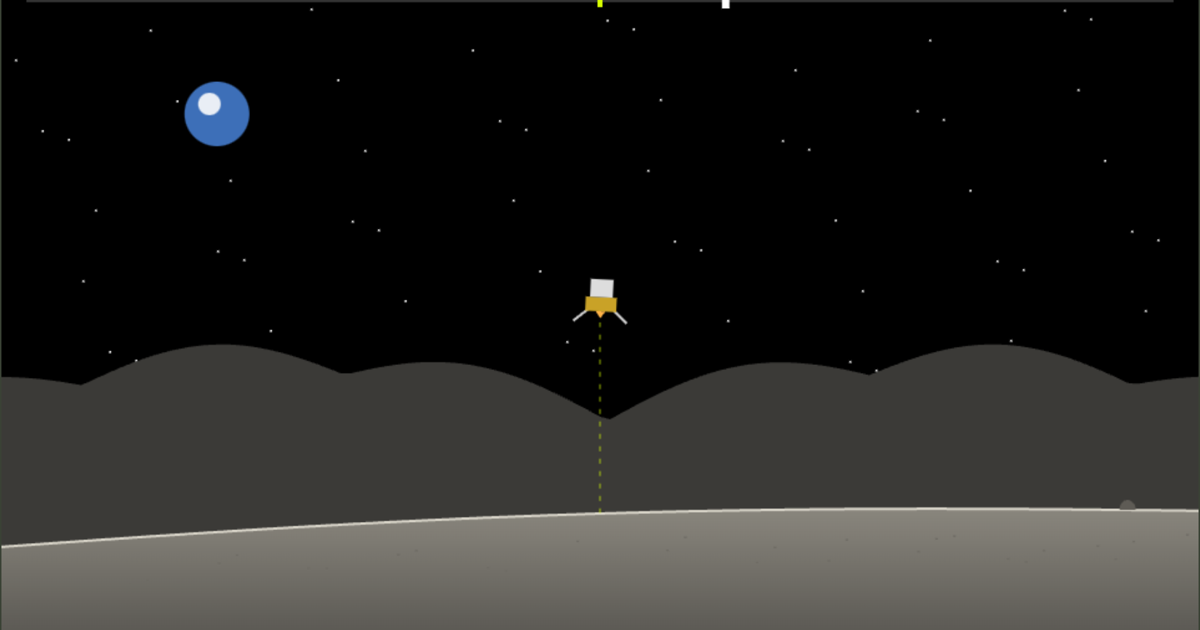
You've taken over from the computer for the last few hundred metres. Real lunar gravity, the real descent engine, a landing radar, boulders and craters under you, and a fuel gauge that won't wait.
Put it down on the target, gently, before the fuel runs out. Six real landing sites, a new one every day.
Keys: Q and E, or the left and right arrows, pitch the craft back and forward, up and down step the throttle through its detents, A and D fire the side thrusters, Space is abort stage, G answers an alarm, R flies again. Land under 3 m/s down and 1.2 m/s sideways, within 6° of upright, on ground under 12° with no boulder taller than 0.6 m. Tilting more than 30° blinds the radar.
The Moon pulls at 1.62 m/s², a sixth of Earth's, and there's no air, so nothing slows you but the engine. The lunar module's descent engine gave about 45,000 newtons. It could be throttled between about 10% and 60%, or run at full thrust, but not in between, because that range wore the nozzle. Here the throttle steps in 5% detents, like a careful pilot nudging it. Burning at a specific impulse of 311 seconds, it used about 14.8 kg a second at full thrust.
To hover, thrust must equal weight. With about 7,800 kg of lander that's close to 28% throttle, which sits between two detents, so you have to keep working it. To move sideways you tilt the whole craft and let the engine push you, then tilt back to stop. That's how the crews flew it. The reaction control thrusters can shove you sideways directly too, but at only about 0.1 m/s², so they're for the last few metres.
The landing radar measured height and speed off the surface. Tilt too far and its beams no longer see the ground, so the readouts drop out. During Apollo 11 the guidance computer threw 1202 and then 1201 program alarms: it had more work than time. It shed the low priority jobs and kept flying, and Steve Bales in Mission Control called go. In the game an alarm freezes your displays until you answer it.
The gear was built for about 3 m/s down, 1.2 m/s sideways and a 12° slope, with the descent stage riding not far above the surface, so a big boulder under it is a problem. Out of fuel near the ground, the real crews would have fired the abort stage: the ascent stage separates and climbs away on its own engine. It saves the crew but ends the landing.
Six crews landed between July 1969 and December 1972. Apollo 11 came down in the Sea of Tranquillity after Armstrong flew past a boulder field by West crater with about 30 seconds of fuel called. Apollo 12 landed in the Ocean of Storms, close enough to walk to the Surveyor 3 probe. Apollo 14 went to the hilly Fra Mauro highlands, Apollo 15 beside the deep Hadley Rille, Apollo 16 to the rough Descartes highlands and Apollo 17 into the narrow Taurus Littrow valley. Each day brings one of them, with terrain made up in its character.
A landing scores for softness, staying level, not sliding and fuel left, then multiplies by precision: ×3 within 30 m of the target, ×2 within 100 m. Commander pays ×1.5 and Armstrong ×2. Abort and you score nothing, but the crew is safe. You can fly today's landing again as often as you like, and your best counts.
I'm Arthur. I'm not a pilot or an engineer, just someone who has watched the landing footage far too many times. If you know better, email me. For more space, try Orbit.
One email when a new game is out. Nothing else.