
Job
Job
To go
Load above ground
Swing, m/s
Skids above ground
Climb
Ground speed
Collective
Fuel
Wind
On the hook
Time
Heavy lift helicopter
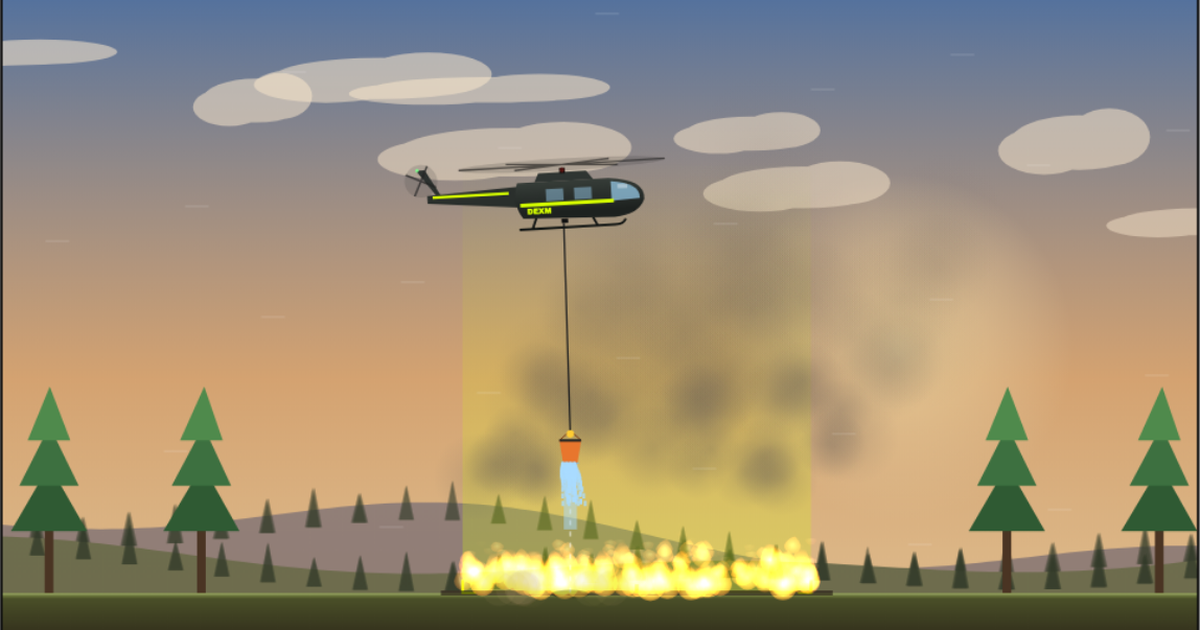
A heavy lift helicopter, a long rope and something heavy on the end of it. Hook a crate, carry it across the yard and set it down on the mark. Then an air conditioning unit onto a roof, a log out of a forest, a bucket of lake water onto a fire and a steel bridge span onto two piers.
The load is a real pendulum: it lags when you speed up and swings ahead when you brake. Hover hold and a swing damper are on to start with, so it is easy to pick up. Score for a load set down on the mark, steady, soft, quickly and with fuel to spare.
Daily Drop · same job for everyone, every UK day
Seven jobs, each a little harder. Wind arrives from job three.
Keys: W and S up and down, A and D tilt, Space releases the load or opens the bucket, P pauses. On a phone, use the buttons under the picture.
Hold A or D to tilt the rotor and fly that way; let go and hover hold brakes you to a stop. Hold W to climb and S to come down; let go and it holds the height, and coming down it slows itself in the last few metres. Lower the hook onto the top of a load and it latches. Set the load on the target and the hook lets go, or press Space. With the bucket, dip it in the lake to fill it and press Space over the fire. P pauses, R flies again, N goes to the next job.
Heavy lift helicopters carry things that will not fit inside: air conditioning units for rooftops, logs from steep forest, buckets of water for fires, sections of bridges and towers. The load hangs on a long rope, a long line, under the helicopter, and the pilot flies looking down at it.
A load on a rope is a pendulum. Speed up and it trails behind you; brake and it swings on past. The time of one swing depends only on the rope: about 8 seconds on a 15 m rope and 11 on a 30 m one. The trick is to move smoothly, brake early and wait for the swing to die before you set the load down.
In the game the helicopter weighs 9 tonnes and its rotor can lift about twice that. Tilting the rotor turns some of the lift sideways, which is how a helicopter flies forwards; it needs a little more power to hold height while it does. The heavier the load, the more power it takes to hover, which you can see on the collective. Low over the ground the rotor gets a little extra lift from ground effect, and its downwash blows dust, spray and leaves out from under it.
Both are on to start with. Hover hold brakes you to a stop when you let go of A or D, even in wind, holds your height when you let go of W or S, and slows the descent in the last few metres above the ground so the load comes down softly. Once the load is sitting on the target with the rope slack it lets go of the hook for you. The swing damper calms the pendulum, a little like a pilot making small corrections and a stabilised hook. Turn either off on the job list for a ×1.15 bonus each. Without hover hold, W and S move the collective and you hold the height yourself.
Each job scores up to 1000: 400 for how close the load lands to the mark, 250 for steadiness, meaning how little it is swinging when it touches down, 150 for a soft touchdown, 100 for beating the par time and 100 for fuel left. S is 900 or more, A 780, B 640, C 480. The total is then multiplied by the job, from ×1 for First lift to ×3 for the bridge. Bring a load down too hard and it breaks; hit a building or a tree with the rotor and the job is over. Your best score and grade on each job is kept on this device.
Every day there is one job for everyone, chosen by the date in the UK: crates, a rooftop, a log, a fire or a bridge, with its own distances, rope and wind. You get one scored try and a share card with your grade and five squares, one for each part of the score. After that you can practise it as much as you like. The next one arrives at midnight UK time.
I'm Arthur. I'm not a helicopter pilot, I just love watching sling load work. The helicopter, the jobs and the numbers are my own, simplified to make it fun to fly. If you know better, email me. If you like this, try landing a rocket in Booster.
One email when a new game is out. Nothing else.