
Descent
Height above deck
Vertical speed
Sideways speed
To deck centre
Tilt
Throttle
Fuel, hover time
Thruster gas
Legs
Wind
Deck, m/s
Mach
Engine heat
Booster recovery
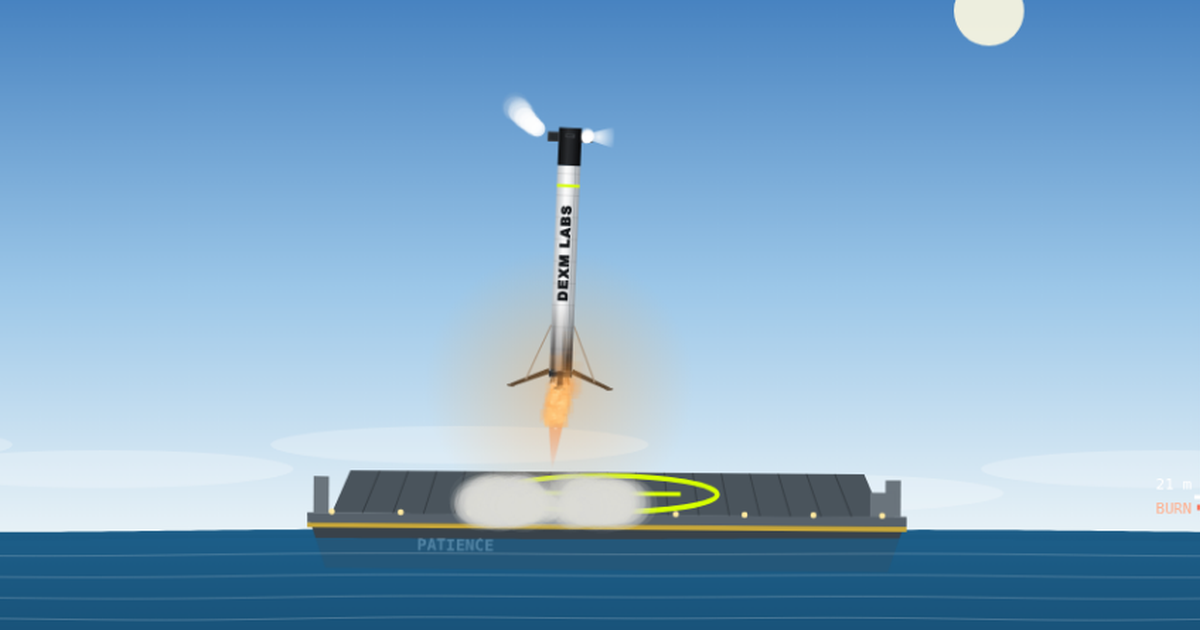
Land a slim white DEXM Labs booster on a heaving ship at sea, hover a giant stainless booster between the tower arms, or try my new Ship Catch: belly flop the Giant ship in, flip it upright and slot it into the chopsticks.
Coast, light the engine late, lean with the grid fins, then feather it onto the deck or into the catch window. Score for a soft, level, centred finish with fuel to spare.
The nine levels: Calm, Windy, Night and Storm on the drone ship; Catch: calm, Catch: crosswind and Catch: night at the tower; Ship Catch, and the bonus Double Catch, booster then ship, for one combined score. Share a mode straight away with ?level=ship-catch or ?level=double-catch.
Daily Drop · same flight for everyone, every UK day
Keys: W and S throttle, Q and E lean, A and D gimbal the engine, L legs, C closes the tower arms. On the ship, Q and E pitch it with the flaps and A and D tuck or spread them. On a phone, use the buttons under the picture.
Independent fan-made game inspired by real reusable rockets. Not affiliated with or endorsed by SpaceX.
W and S, or up and down, step the throttle 5% at a time; it lights at 40% and goes off below that. Space is full thrust and X cuts the engine. Q and E, or left and right, lean the booster; let go and it holds that angle. A and D swing the engine to push you sideways while it burns. L deploys the legs, below 90 m/s. P pauses, R flies again, N goes to the next level. Land under 4 m/s onto the deck, sliding under 2 m/s, within 8° of the deck, with the legs on it.
Your Daily Drop card
After it has pushed the upper stage on its way, the first stage of a reusable rocket turns round and falls back, engines first. It has very little fuel left, so almost all the slowing down is done by the air and by one short, late, hard burn. Out at sea a flat ship holds station with its own thrusters and waits.
In the game the booster weighs about 20 tonnes empty and carries a few tonnes of fuel. Its engines give 440 kN together, about twice its weight, and burn around 150 kg a second at full thrust. It throttles from 40% to 100%. At 40% it is a little weaker than gravity, so you can come down gently, and around 55% it hovers, though that eats fuel fast. The air does the rest: falling through thick air the booster settles at about 140 m/s, faster higher up where the air is thin.
The red BURN mark on the height tape shows where a full thrust burn started now would stop you, ignoring the air. Light the engine a little above it, then ease off as you slow. Hovering all the way down works, but it costs most of your fuel, and fuel left is points.
Q and E fire small cold gas thrusters at the top to lean the booster. Let go and the flight computer holds the angle, just as it does in the Apollo game. With the engine burning, a lean turns some of the thrust sideways, which is how you cover big distances. With the engine off, the grid fins at the top let you glide: lean the way you want to go and the air pushes you there.
A and D swing the engine a few degrees on its gimbal. In the game the computer keeps the booster upright while you do it, so it works as a fine sideways push for the last few metres. It only works while the engine is lit.
Wind pushes the long body sideways, more strongly higher up, and it gusts. The deck heaves up and down and pitches end to end with the swell, so the touchdown speed that counts is your speed relative to the deck. A deck rising into you lands harder. The deck readout says whether it is rising or falling.
On the night and storm levels you start supersonic. Coming through thick air that fast heats the engine section, so you light the engine for a few seconds high up. That is the entry burn: it slows you, and the plume pushes the hot shock away from the engines. Slow through Mach 1 and you leave a sonic boom behind you. Legs come out only below 90 m/s, because the airflow would tear them off.
The big stainless booster has no legs. It flies back to the launch site and the tower catches it: two arms on a carriage swing shut under a pair of catch pins just below the grid fins. Come in beside the tower, on the right of it, never over it. Slow to a hover with the pins level with the arms, centred between them, and press C. The arms take most of a second to close, so you need to be steady when they arrive: within 3 m up or down and 3 m of centre, drifting under 2 m/s, coming down under 2.5 m/s and tilted less than 6°. Miss and they open again for another try, if you have the fuel. Close them on the side of the booster and it's over.
With arm assist on, the carriage rides up and down to meet your pins and the tower closes the arms the moment you are in the window. It is much easier and scores ×0.75. The panel on the left of the picture shows each part of the window going green.
The Giant ship is the upper stage: a tall stainless cylinder with a pointed nose, black heat shield tiles on its belly and four flaps, two small ones at the front and two big ones at the back. It comes home flat on its belly. Q noses it down and glides you towards the tower, E noses it up and brakes. With the engine off, A tucks the flaps in to fall faster and D spreads them to fall slower.
Watch the blue FLIP mark on the height tape and the flip zone about 75 m short of the arms. When they meet you, press W to light the engine and hold E. The gimbal swings the ship upright in a couple of seconds, and the flip carries you in towards the tower. Then it flies like the boosters: a short burn on very little fuel, the pins level with the arms, under 2 m/s of drift and 2.5 m/s coming down, within 6° of upright, and C closes the arms. Flip too late and you will not stop in time; flip too close and you will hit the tower.
The Double Catch strings two catches together. Catch the giant booster, press N, then catch the ship. The scores add up, with 25% on top if you catch both.
A landing scores 200, plus up to 300 for a soft touchdown, 150 for landing level with the deck, 100 for not sliding, 350 for landing near the centre of the ring, 250 for fuel left and 150 for a bullseye within 3 m. Windy pays ×1.5, Night ×2 and Storm ×3. Catches score the same way against the catch window: calm ×1.5, crosswind ×2.5, night ×3.5 and Ship Catch ×3. Your best on each level is kept on this device. After any flight, V plays back the last five seconds at half speed.
I'm Arthur. I'm not a rocket engineer, I just love watching boosters come back. The two boosters and the ship wear my DEXM Labs livery and are inspired by the real reusable rockets, but the physics is simplified to make it fun to fly, and the numbers, the ship and the tower are my own. If you know better, email me. If you like this, try landing on the Moon in Apollo.
One email when a new game is out. Nothing else.